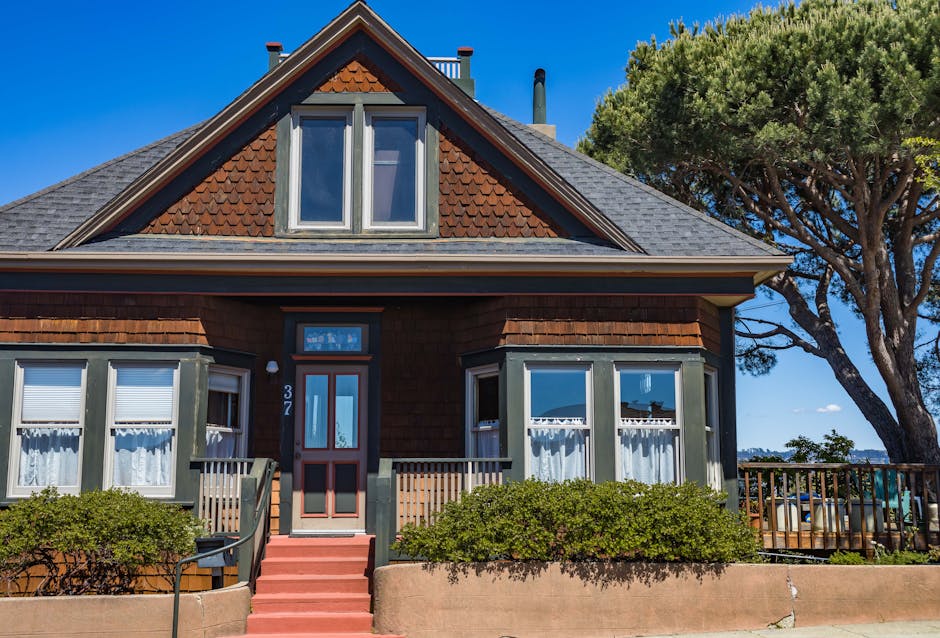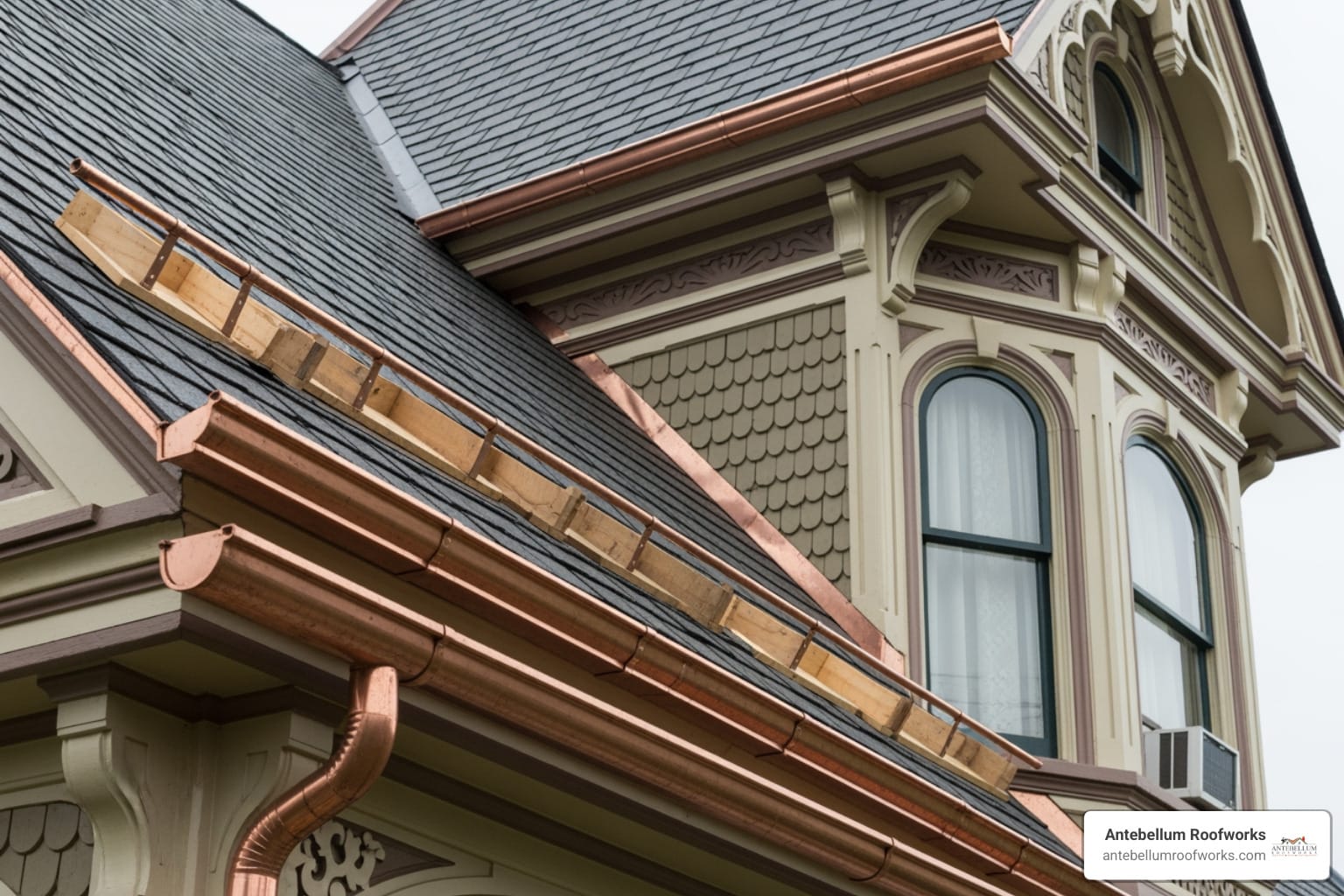

What Is a Cresting Roof — and Why Does It Matter for Your Home?
A cresting roof is a decorative architectural feature installed along the ridge, cornice, or parapet of a building to enhance its silhouette and visual character. Here’s a quick breakdown:
| Feature | Details |
|---|---|
| What it is | Ornamental metalwork or tilework running along the roof ridge or parapet |
| Common materials | Copper, wrought iron, cast iron, wood, aluminum, PVC |
| Where it’s installed | Roof ridges, cornices, copings, and parapets |
| Key purposes | Aesthetic enhancement, weather protection, bird deterrence |
| Associated styles | Victorian, Second Empire, Gothic Revival, Queen Anne |
| Typical lifespan | Copper cresting can last 50+ years, often exceeding a century |
Walk down any historic street and you’ll notice the skyline isn’t flat. The rooflines of older homes and civic buildings have a rhythm to them — a decorative edge that draws your eye upward and gives the structure a finished, purposeful look. That’s roof cresting at work.
It’s one of the most overlooked details in architecture. But once you know what it is, you’ll see it everywhere — from the iron lacework on a Victorian mansard roof to the subtle clay ridge tiles capping a craftsman bungalow. As one architectural writer put it, cresting is what witches, black cats, and full moons have in common: it’s the silhouette that defines the roofline against the sky.
Cresting isn’t just decorative. It protects exposed roof edges from weather, discourages birds from roosting, and signals the craftsmanship and character of a building. For homeowners in Middle Tennessee preserving a historic property or building something new with lasting curb appeal, understanding this detail matters — and it’s where expert roofing craftsmanship makes all the difference.
I’m Kevin Heithcock, owner of Antebellum Roofworks, and I’ve spent 30 years working with residential and historic properties across Middle Tennessee — including hands-on fabrication of custom copper accents, finials, and cresting roof details that most contractors simply don’t offer. In this guide, I’ll walk you through everything you need to know about roof cresting: what it is, where it came from, how it’s installed, and how to get it right.
What is a Cresting Roof?
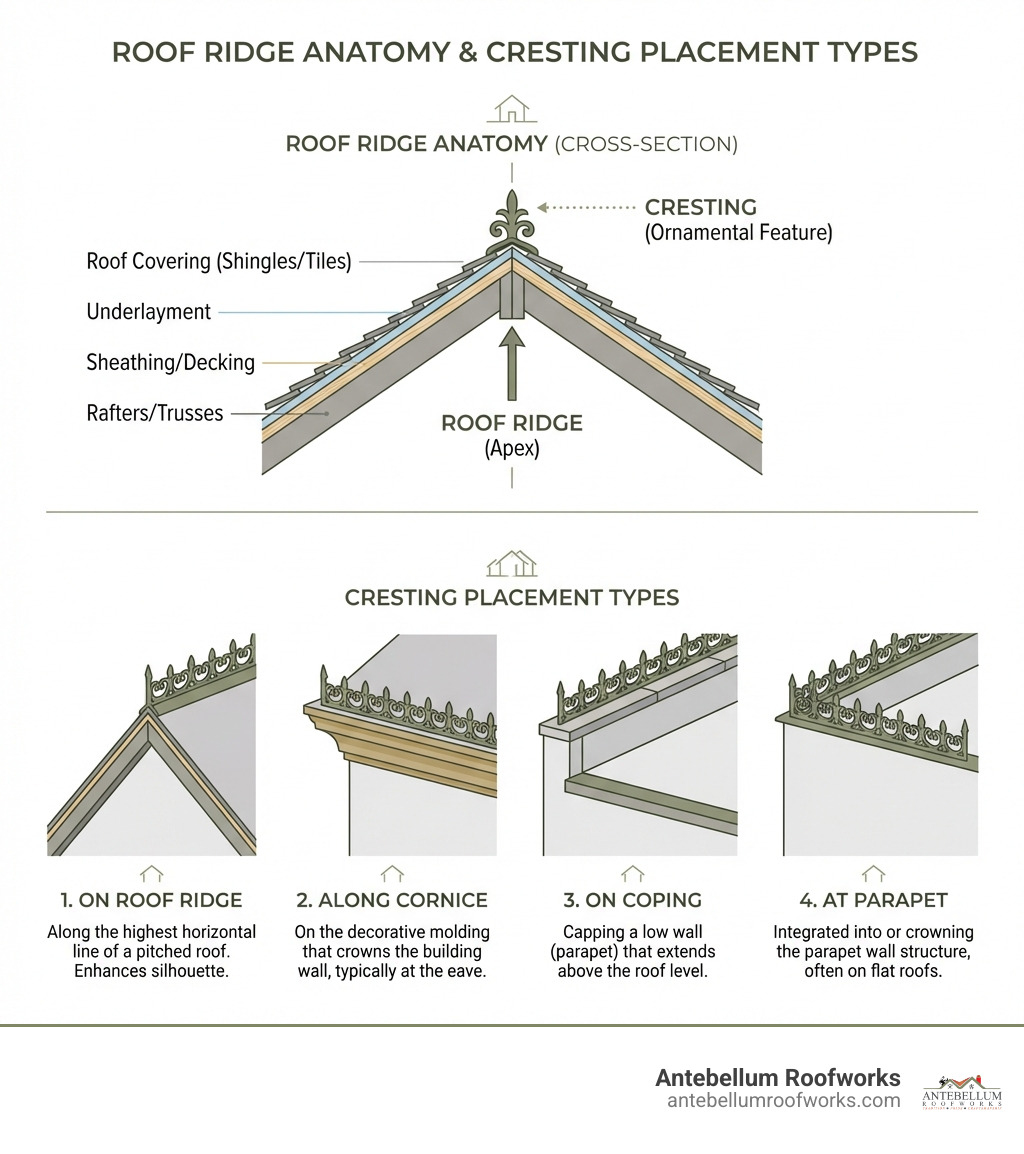
To truly understand a cresting roof, we have to look at it as the “crown” of the building. In technical terms, cresting is ornamentation attached to the ridge of a roof, a cornice, a coping, or a parapet. While it looks like a miniature fence, it serves a very different purpose than the railings you see on a porch or balcony.
Defining the Terms
According to the Victorian ornamentation glossary, cresting is specifically designed to provide a visual termination to the roofline. It creates an illusion of greater height and breaks up the heavy visual mass of a large roof.
We often see it applied in three primary areas:
- The Ridge: The very peak where two roof planes meet.
- The Cornice: The decorative projection at the top of a wall.
- The Parapet: A low protective wall along the edge of a roof or balcony.
Cresting vs. Balustrades and Widow’s Walks
It is easy to confuse cresting with other roof features, but the distinction is critical for both aesthetics and safety.
- Roof Cresting: This is purely decorative or functional for bird/weather protection. It is usually short (often between 3.5 and 7 inches) and is not designed to support the weight of a person.
- Balustrades: These are functional railings. If a roof is “walkable,” building codes usually require a balustrade.
- Widow’s Walks: These are small, railed platforms atop a roof, traditionally used in coastal areas for spotting ships. Because they are meant to be stood upon, they require much taller railings (usually 36 inches) than standard decorative cresting.
Historical Evolution: From Viking Ships to Victorian Mansions
The history of the cresting roof is a journey through global craftsmanship. Long before it became a staple of American Victorian homes, decorative roof edges were a symbol of status and protection across Europe and Scandinavia.
Ancient Origins
As early as 1100 A.D., Norway’s famous Stave churches featured intricate wood carvings along their roof ridges. These designs often mimicked the prow of Viking ships, serving as a cultural signature that could be seen from a distance. Similarly, in Central Europe, thatched roofs often featured “sculpted” ridges where the reeds were layered extra thick and shaped into artistic patterns to improve water runoff.
The Victorian Golden Age
The historical significance of roof ornamentation reached its peak in the late 19th century. During the Second Empire and Gothic Revival eras, cresting became a defining feature of the “Mansard” roof. By the 1890s, the industrial revolution allowed for mass-produced sheet metal cresting. This meant that even modest Queen Anne cottages could sport the same “iron lace” previously reserved for grand mansions.
In these eras, cresting wasn’t just a fashion choice; it was a way to direct the eye skyward, emphasizing the verticality and grandeur of the architecture.
Materials and Styles of Modern Roof Cresting
Choosing the right material for your cresting roof is a balance between historical accuracy, budget, and how much maintenance you’re willing to do. In Middle Tennessee, we deal with high humidity and fluctuating temperatures, which makes material choice even more vital.
| Material | Pros | Cons | Lifespan |
|---|---|---|---|
| Copper | Naturally corrosion-resistant; beautiful patina; highly durable. | Higher initial cost. | 50–100+ Years |
| Wrought Iron | Authentic historical look; very strong. | Requires regular painting to prevent rust. | 50+ Years (with care) |
| Cast Iron | More affordable than wrought iron; intricate details. | Brittle; prone to rust if not maintained. | 30–50 Years |
| Wood | Highly customizable; traditional feel. | Prone to rot and insect damage; needs sealing. | 10–20 Years |
| Aluminum/PVC | Lightweight; low maintenance; won’t rust. | May lack the “heft” or authentic feel of metal. | 20–30 Years |
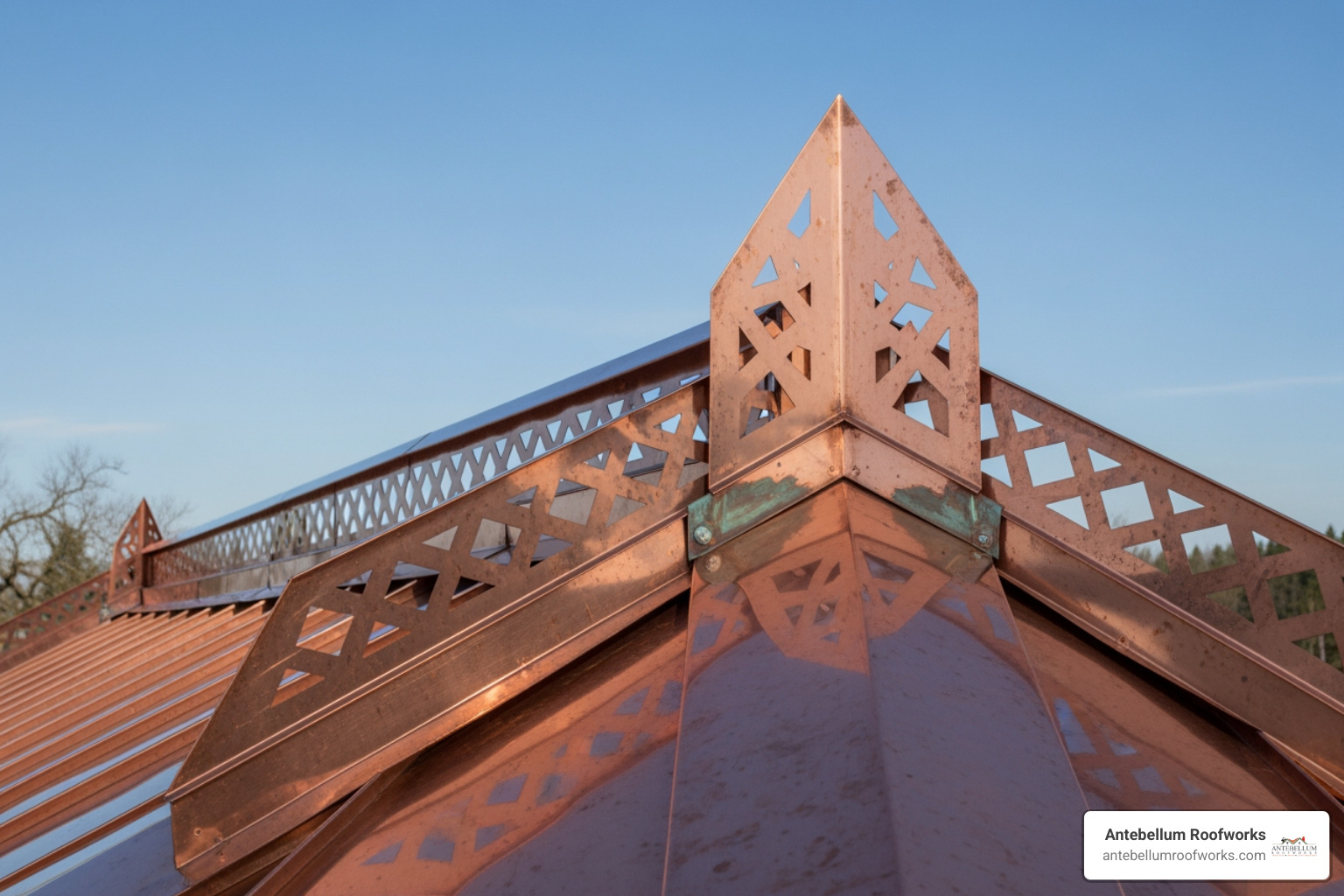
For those looking for the “gold standard,” we often recommend copper. As noted in The Ultimate Guide to Decorative Ridge Caps, copper cresting is typically available in 16oz or 20oz thicknesses. Its greatest strength is the natural patina it develops—a protective layer that ensures the metal actually gets tougher (and more beautiful) as it ages.
Popular Styles of Roof Cresting
Modern manufacturing allows us to recreate classic themes or invent new ones:
- Draco: Inspired by dragon scales or gothic flourishes.
- Gothicus: Features pointed arches and sharp, vertical spires.
- Oculus: A cleaner, geometric style with alternating curves and circular projections.
- Lillium: Floral motifs, often featuring the lily or fleur-de-lys, popular on Victorian gazebos.
Material Durability and Maintenance
While metals like aluminum and PVC are great for low-maintenance modern builds, historic restorations in Franklin or Nashville often require the real deal. If you have iron cresting, you must inspect it annually for rust and apply specialized treatments. If you prefer a masonry look, Decorative Roof Ridge Tiles made of clay or terra cotta offer a subtle, earthy alternative that caps the ridge with elegance.
Design Principles: Proportion, Building Codes, and Curb Appeal
The biggest mistake homeowners make with a cresting roof is getting the scale wrong. Architecture is all about rhythm and proportion. If the cresting is too tall, the house looks like it’s wearing a “cheap crown.” If it’s too small, it disappears against the sky.
The Problem with “Zoo Cage” Aesthetics
We have seen many modern builders try to install standard porch railings on a roof ridge. This is a disaster for curb appeal. Porch railings are designed for safety and are bulky; when placed on a roof, they look like a child’s playpen or a cage at a zoo.
True roof cresting should appear light, airy, and continuous. It should harmonize with the architecture’s existing lines rather than fighting against them.
Navigating Building Codes
If you are installing cresting on a non-accessible roof ridge, there are generally no height requirements. However, if you are building a walkable widow’s walk, modern safety codes require railings to be at least 36 inches high.
- The Conflict: A 36-inch railing on a small historic home often looks visually jarring and out of proportion.
- The Solution: We can often use “architectural hacks” to satisfy inspectors while saving the home’s look. This might include raising the roof edge slightly or setting the floor of the widow’s walk lower than the ridge line to hide the bulk of the railing.
Installation and Functional Benefits
Installing a cresting roof is a precision job. Because you are essentially poking holes in the highest point of your home, waterproofing is the number one priority.
The Installation Process
- Mounting Brackets: Cresting is typically secured using specialized brackets that are spaced and aligned to ensure a perfectly level line.
- Bolts and Sealants: We use heavy-duty bolts to anchor the cresting to the structural ridge. Every bolt must be covered with high-grade sealants during construction to prevent water penetration and eventual corrosion.
- Pitch Considerations: For low-pitch roofs, special care is needed. Some clay cresting tiles can work on pitches as low as 10 degrees, but they require mechanical stainless steel clips rather than standard nails to stay secure.
Beyond Decoration: Functional Benefits
While most people want cresting for the “wow factor,” it actually works for your home:
- Bird Deterrence: The pointed nature of many cresting styles (like the Sagitta or Gothicus) makes it uncomfortable for birds to roost on your ridge, keeping your roof cleaner.
- Ventilation: Some ridge cresting systems are designed to work with ridge vents, allowing hot air to escape more efficiently from your attic, which can lower cooling costs in our hot Tennessee summers.
- Weather Protection: By capping the ridge, cresting provides an extra layer of defense against wind-driven rain and snow at the roof’s most vulnerable point.
If you’re considering adding this feature, it’s best to consult with a professional who understands the structural implications. You can reach our team for a consultation at (615) 794-9111.
Frequently Asked Questions about Roof Cresting
What is the difference between roof cresting and a widow’s walk?
Cresting is a decorative ornament (usually 3-7 inches tall) that runs along the ridge of a roof. A widow’s walk is a functional platform designed for people to stand on, requiring a much taller, safety-compliant railing (usually 36 inches).
How long does copper roof cresting typically last?
Copper is one of the most durable materials on earth. A well-installed copper cresting roof can easily last 50 to 100 years. Many historic buildings in the U.S. still have their original copper cresting from the 1800s.
Does roof cresting require special building permits?
In most cases, adding decorative cresting to a non-walkable roof does not require a special permit. However, if you live in a historic district (like many parts of Franklin, TN), you may need approval from a local architectural review board to ensure the design matches the period of your home.
Conclusion
A cresting roof is more than just “architectural jewelry.” It is a nod to a time when craftsmanship was the standard and every detail of a home was designed to tell a story. Whether you are restoring a 19th-century Victorian or adding a custom touch to a new build, cresting provides that final, elegant “period” at the end of your home’s architectural sentence.
At Antebellum Roofworks, we take pride in being one of the few contractors in Middle Tennessee with the specialized knowledge to handle these intricate details. From sourcing authentic salvage pieces to fabricating custom sheet metal in our own shop, we ensure your roof’s peak is as functional as it is beautiful.
If you’re ready to elevate your home’s silhouette, give us a call at (615) 794-9111. Let’s build something that stands the test of time.