
Decorative Roof Finials: The Architectural “Crown” That Boosts Curb Appeal, Seals Roof Peaks, and Can Lift Resale Value
Decorative roof finials are ornamental crowning elements installed at the apex of a roof, gable, or cupola to finish the roofline and protect the most failure-prone seam where materials meet. Homes with period-appropriate finials commonly command higher resale values than comparable properties without them, because they strengthen architectural authenticity and curb appeal. For homeowners who want the detail done correctly (and watertight), the fastest path is working with an experienced team like Middle Tennessee roofing specialists and confirming the finial is integrated with proper flashing.
Finials began as practical caps meant to reduce water intrusion at ridges and peaks; modern installs still deliver that benefit when they’re correctly fabricated and sealed. A well-sized finial also reduces recurring ridge/apex touch-ups by protecting vulnerable joints and trim.
Quick Guide to Choosing Roof Finials (style + best-fit):
- Ball/Globe finials — Classic, versatile profile for Colonial and traditional homes
- Fleur-de-lis finials — French-inspired formality for historic and high-detail facades
- Spike/Spire finials — Strong vertical emphasis for Gothic and Victorian rooflines
- Dragon/Figurative finials — Statement pieces for one-of-a-kind character homes
- Geometric finials — Clean silhouettes for contemporary architecture
- Copper finials — Premium metal that develops a protective patina
- Aluminum finials — Lightweight, rust-proof, and paintable
- Concrete/Clay finials — Traditional materials suited to historic restoration
As documented in J.W. Fiske’s 1893 writings on architectural ornament, finials help “break the sharp transition between building and open sky,” creating visual harmony that reads as “finished” from the street.
For Middle Tennessee homeowners planning a roof replacement, a thoughtfully chosen finial can transform an ordinary ridge into a signature architectural detail. If you want help sourcing, fabricating, or installing a finial that matches your home’s era and roof system, reach out to the team at Antebellum Roofworks.
From Ancient Pagodas to Modern Mansions: The 2,300-Year Evolution of Roof Finials

Archaeological evidence dates the first roof finials to around 300 BCE in ancient Greece, where they sealed temple roofs against Mediterranean storms. This crucial function protected the structural integrity of early buildings, significantly reducing water damage at vulnerable roof peaks. Over time, this functional piece evolved into a canvas for artistic expression, making decorative roof finials far more than simple caps.
Finials gained prominence in Asian cultures around 700 A.D. on pagodas, often as lotus buds symbolizing enlightenment. In Europe, function merged with artistry. Gothic architecture embraced finials with dramatic flair, carving gargoyles, dragons, and floral crockets for towering spires and gables, often with deep symbolic meaning. The Victorian era (1837-1901) saw a dramatic increase in finial production, with a wide variety of documented styles allowing homeowners to display wealth and individuality.
The Dual Role of Finials: Function and Symbolism
Throughout history, decorative roof finials have served a fascinating dual purpose, blending the practical with the profound. Modern engineering studies confirm that properly installed finials can meaningfully reduce wind uplift at roof peaks.
- Weatherproofing: Fundamentally, finials sealed the roof’s apex, preventing water, wind, and pests from entering the structure. This was especially important for tiled roofs where the ridge is a weak point.
- Structural Integrity: On some early round roofs, a finial’s weight helped hold tiles in place, contributing to the roof’s overall stability.
- Status Symbol: Historical records show that finial size and elaborateness often correlated with social status — wealthy Victorian homeowners tended to install larger, more ornate finials than those on more modest homes.
- Religious Symbolism: From the lotus buds of Asian pagodas to the crosses on European churches, finials often carried significant religious meaning. The ‘kalasha’ finial on Hindu temples, for instance, is placed atop a dome to symbolize divinity.
- Folklore and mythology: Some finials were thought to have magical properties. A charming American folklore tradition suggests finials prevented witches from landing on the roof, acting as a magical deterrent.
- Architectural Emphasis: Finials draw the eye upward, emphasizing a building’s height and grandeur. They act as an architectural exclamation point, completing the composition.
- Warding Off Evil Spirits: Figurative finials like dragons or gargoyles were believed to ward off evil spirits and protect the building’s inhabitants.
Finials Across Architectural Eras: A Timeline of Design Evolution
The evolution of finial designs mirrors the rich mix of architectural history, with each era leaving its unique mark. Restored Victorian homes frequently include period-appropriate finials as a key element of historical accuracy.
- Ancient Greece & Rome (300 BCE – 500 CE): Finials trace back to ancient civilizations like Egypt and Greece, serving decorative and symbolic functions. Though less ornate than later styles, they marked significant points on structures.
- Asian Pagodas (700 CE – Present): As early as 700 A.D., finials became prominent on pagodas in Asian cultures, often incorporating symbolic elements like the lotus bud.
- Gothic Revival (1740s – 1930s): Inspired by medieval cathedrals, this period saw a rise in complex and prominent finials on homes, featuring religious symbols, crockets (stylized foliage), and mythical creatures.
- Tudor (1485 – 1603): From 16th-century English architecture, Tudor-style homes often feature simpler, robust finials that complement their half-timbered facades and steep gables.
- Victorian Styles (1837 – 1901): Arguably the golden age for decorative roof finials, they were integral to styles like Italianate, Queen Anne, and Stick Style. A remarkable number of unique finial designs were produced and patented during this period.
- Chateauesque & Second Empire (1860s – 1890s): These grandiose styles, with their towering mansard roofs, frequently incorporated impressive finials to accentuate turrets and roof ridges, adding to their fairytale castle aesthetic.
- Richardsonian Romanesque (1880s – 1900s): Known for its heavy stone masonry, this style also used finials, often in simpler forms that harmonized with the overall architectural mass.
Finials have been an integral part of many architectural periods, including Medieval, Tudor, Gothic Revival, and all the Victorian styles. Their enduring presence speaks to their timeless appeal. To dig deeper into how these elements contribute to historical structures, you can explore More on historical architecture.
Material Science Meets Artistry: The Engineering Behind Finial Selection
Material selection is one of the most important factors in determining a finial’s lifespan and maintenance requirements. Copper finials are known to last many decades — often 80 years or more — while untreated wood may only last 15-25 years in Tennessee’s climate. Modern fabrication offers homeowners in Middle Tennessee unprecedented choices, with each material having unique properties influencing weight, weather resistance, and aesthetic evolution.
| Material | Durability | Maintenance | Aesthetic | Cost |
|---|---|---|---|---|
| Copper | Excellent (80-150 years documented lifespan) | Low (Develops protective patina naturally) | Classic, neat; changes from shiny to blue-green patina over time | High ($300-$2,000+ per finial) |
| Aluminum | Very Good (40-60 years) | Low (May require occasional cleaning) | Modern, versatile; can be painted any color to match | Moderate ($150-$800) |
| Terracotta/Clay | Good (30-50 years if properly fired) | Moderate (Can be brittle, susceptible to cracks) | Traditional, earthy; available in various natural hues | Moderate ($100-$600) |
| Concrete | Good (25-40 years) | Low to Moderate (Can absorb moisture, moss growth) | Robust, classic; can be molded into intricate designs; paintable | Moderate ($75-$500) |
| Lead Coated Copper | Excellent (100+ years) | Low (Maintains a consistent gray appearance) | Uniform matte gray finish, often chosen for historical accuracy | High ($400-$2,500+) |
| Zinc | Excellent (75-100 years) | Low (Develops a natural, soft gray patina) | Distinctive matte gray finish, subtle and sophisticated | High ($350-$2,000+) |
| Wood | Fair to Good (15-25 years with treatment) | High (Needs regular sealing, painting, or staining) | Natural, rustic charm; versatile for carving | Low to Moderate ($50-$400) |
The Enduring Appeal of Copper Decorative Roof Finials: A Long-Term Investment
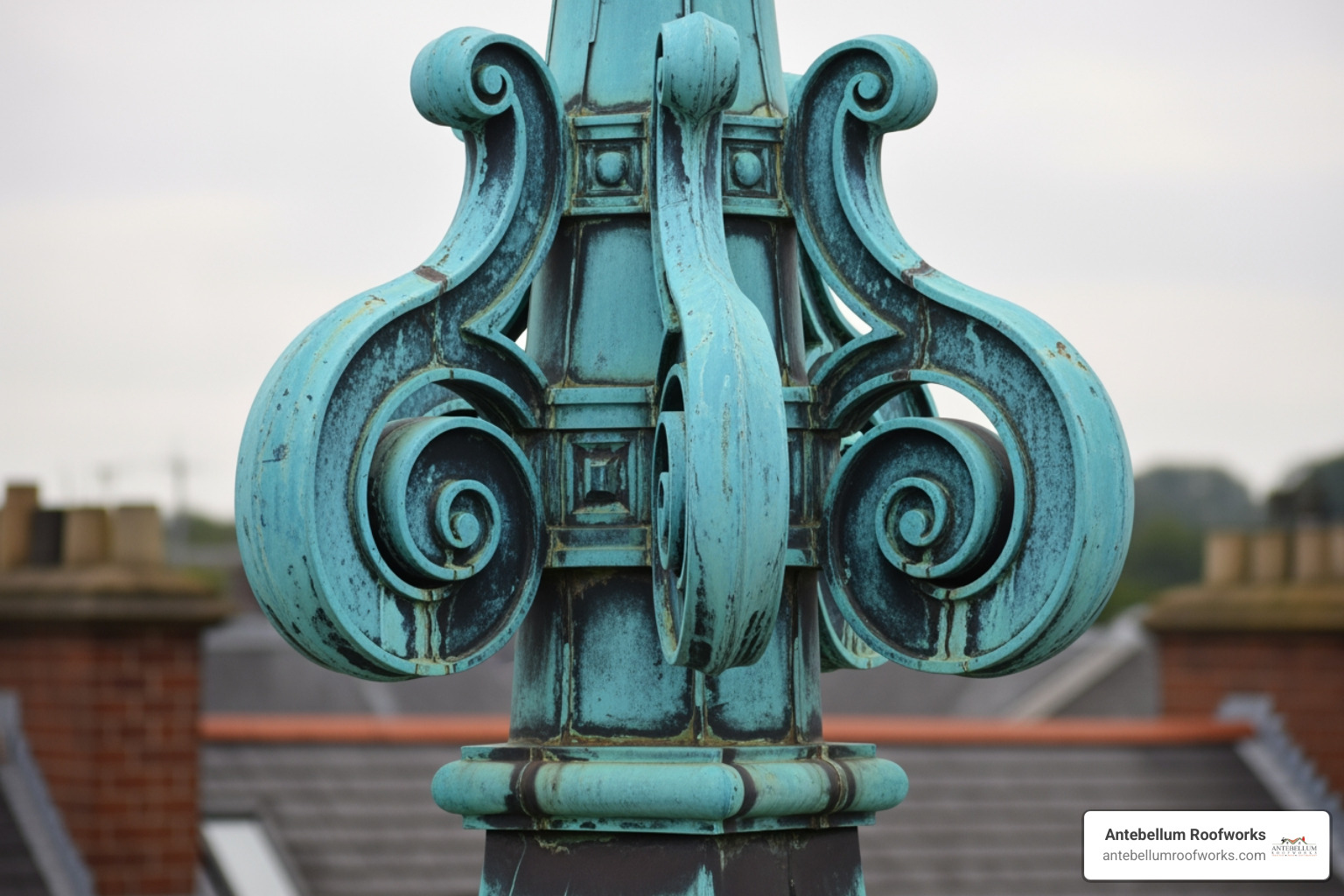
When it comes to decorative roof finials for a Tennessee home, copper delivers outstanding long-term value. Copper’s exceptional corrosion resistance makes it well suited for exterior elements that must withstand local weather for decades.
A new copper finial is brilliant and shiny, but its true charm unfolds over time. Within several years, it develops a distinctive blue-green patina (verdigris), which is not decay but a natural protective coating that shields the metal. This ensures the finial can last for a century or more, making it a sustainable choice. The durability of copper is proven by original copper roofing from the 1700s that still exists today — the Christ Church in Philadelphia retains its original 1727 copper finials.
This beautiful change adds history, elegance, and character. That’s why copper is favored for high-end copper roofing projects and historical restorations in Franklin and beyond. Copper’s ability to hold complex shapes while maintaining strength makes it ideal for intricate finial designs.
Modern and Traditional Options for Decorative Roof Finials
While copper holds a special place, decorative roof finials are available in a spectrum of materials to suit every architectural style and budget. Properly installed aluminum finials are engineered to withstand high sustained winds, making them a reliable choice for exposed locations.
- Aluminum: A lightweight, rust-proof, and versatile option that weighs significantly less than copper. Mill finish aluminum provides a clean, contemporary look, but it can also be powder coated or painted to match any color scheme.
- Lead-Coated Copper: This material combines copper’s strength with a uniform matte gray finish, often chosen for historical accuracy where a weathered lead look is desired. It offers excellent long-term color stability.
- Pre-Patina Copper: For those who love the look of aged copper but don’t want to wait decades, pre-patina copper is treated to accelerate the patination process, giving it an instant antique appearance.
- Concrete Mixes: Many finials are crafted from concrete-based mixes, often reinforced with fiberglass for strength. These materials are robust, weather-resistant, and can be molded into highly intricate designs.
- Fiberglass Reinforcement: Often incorporated into concrete or resin finials, this significantly improves strength and durability, making them less prone to cracking.
- Terracotta: A classic choice for a warm, earthy aesthetic, terracotta is popular on traditional and Mediterranean-style homes. It’s durable when properly fired but can be susceptible to freeze-thaw cycles if not sealed.
- Wood: For rustic or traditional homes, carved wooden finials add a charming, handcrafted touch. They require regular maintenance like sealing or painting to protect them from the elements.
- Custom Colors & Powder Coating: Modern manufacturing allows aluminum or steel finials to be powder coated or painted in custom colors. This ensures your finial can perfectly match your trim or roofing for a seamless, personalized look.
When considering materials, think about our Middle Tennessee climate. We need materials that can withstand our humid summers, severe storms, and winter freezes. This is why we recommend robust, weather-resistant options proven to perform well in our region.
A Style Guide to Decorative Roof Finials
Choosing a finial is an exercise in architectural harmony. The right design should complement your home’s style, scale, and existing features. A finial that is too large can overwhelm the roof, while one that is too small may go unnoticed. Consider the roof’s pitch and the complexity of the architecture when making a selection. From the simple elegance of a ball finial on a Colonial home to an ornate dragon atop a Victorian turret, the style possibilities are nearly endless, allowing you to truly personalize your property.
Popular Finial Designs and Their Meanings
The world of decorative roof finials is rich with diverse designs, each carrying its own historical significance and aesthetic appeal. Here are some of the most popular styles:
- Ball or Globe: A classic, versatile design symbolizing unity and completeness. Its clean, spherical shape suits many architectural styles, from traditional Colonial and Georgian to modern homes.
- Fleur-de-Lis: This neat, traditional design (French for “lily flower”) represents royalty, faith, and honor. It’s a sophisticated choice for French-inspired, Gothic Revival, and Victorian homes.
- Spike or Spire: A sharp, vertical design that adds height and drama. Popular in Gothic and Victorian styles, these finials make a powerful statement, emphasizing a structure’s verticality.
- Figurative: These expressive finials are shaped like animals (eagles, dragons), mythological creatures (gargoyles), or human figures. They add a personal, symbolic, or protective touch and are perfect for unique character homes.
- Geometric: Featuring clean shapes like cones or pyramids, geometric finials complement modern and contemporary homes, providing a sleek, minimalist finish.
- Cross: Representing spirituality and culture, cross finials are commonly found on churches and other religious buildings but also appear on some traditional homes.
- Crown: Symbolizing power and prestige, crown finials add a regal touch to any building. They are often elaborate and detailed, perfect for grand estates.
- Curved Leaf/Scroll: These finials incorporate natural, flowing forms like leaves or scrolls. They bring a sense of artistry and elegance, popular in Victorian and Art Nouveau inspired designs.
Matching a Finial to Your Home’s Architecture
Selecting the right finial is about understanding your home’s architectural language and choosing an accent that speaks fluently.
- Victorian Homes: With their love for ornamentation, these homes are a broad canvas for finials. Styles like the Ball & Point, Fleur-de-Lis, Spike, and figurative designs are all appropriate. The key is matching the intricacy and scale to existing details.
- Gothic Revival: For this dramatic style, look for finials that emphasize verticality and intricate detailing. Spikes, spires, and even small gargoyle-like figures are highly appropriate.
- Colonial & Georgian Styles: Simplicity and symmetry are key here. A classic Ball or Globe finial, perhaps in copper, provides an neat, understated finish.
- Modern Architecture: Geometric finials are the perfect complement to modern designs. Think sleek cones or abstract forms in metals like aluminum to maintain a minimalist aesthetic.
- Tudor Homes: Characterized by steep gables, Tudor homes benefit from sturdy, yet understated finials. A simple ball or a robust design would fit well.
- Italianate: With their ornate cornices, Italianate homes can handle more elaborate finials, such as those with scrolls or classic urn shapes.
- Matching Finials to Cupolas: Many Middle Tennessee homes feature cupolas, and a finial is their crowning glory. The finial should be proportional to the cupola’s size and style. A grand cupola needs a larger, more intricate finial, while a smaller one suits a modest design. Copper finials are available in a wide range of sizes, from 13″ to over 53″ high, ensuring a perfect fit.
The goal is to improve your home’s curb appeal and architectural integrity. A well-chosen finial not only completes the roofline but also adds a layer of sophistication and personality.
Installation and Sourcing: Bringing Your Vision to Life
After choosing the perfect decorative roof finial for your Middle Tennessee home, proper installation is the next crucial step. This ensures your finial is secure, weathertight, and able to withstand the local climate for years. Finials can be mounted on a roof ridge, gable peak, turret, cupola, or gazebo. The installation method depends on the finial’s material, weight, and the roof structure.
How Are Roof Finials Installed?
Installing a roof finial is about creating a durable, watertight connection that can endure decades of weather.
- Mounting Options: Finials are typically mounted directly to the roof ridge, a hip end, or a feature like a cupola. Custom bases are often fabricated to ensure a perfect fit with the roof’s angle.
- Roof Pitch: The roof’s angle (pitch) is critical. Finial bases must be precisely angled to sit securely on the ridge. Some are designed for specific ridge tile angles (e.g., 35, 45, 50 degrees) to ensure a seamless fit.
- Base Types: Finials can come with various base types, including square, rectangular, or custom-shaped bases that integrate with the roof’s design.
- Traditional Mortar Bedding: This classic method involves setting the finial’s base into a bed of mortar on the roof ridge, providing a strong, permanent bond common with terracotta or concrete finials.
- Mechanical Fixing: For added security with taller or heavier finials, mechanical fixing straps are often used with mortar. These straps anchor the finial to the roof structure, providing stability against high winds.
- Dry Fixing Methods: Modern roofing often uses dry fix systems. Some finials can be adapted to integrate with these systems, using clips and screws to create a secure installation without wet mortar.
- Weatherproofing: Meticulous attention to weatherproofing is paramount. This involves proper flashing and sealants to ensure no water can penetrate around the finial’s base.
- Professional Installation: While some small finials seem like a DIY project, professional installation is highly recommended for larger or custom pieces. Our experienced team at Antebellum Roofworks understands different roofing materials and structures, ensuring your finial is safely anchored to withstand the elements. We can also integrate lightning protection upon request.
Where to Find the Perfect Finial
Finding the right finial for your home is an exciting part of the process. For homeowners in Middle Tennessee, you have several avenues to explore:
- Specialty Metal Fabricators: For unique, high-quality metal finials in copper, zinc, or aluminum, specialty fabricators are an excellent choice. They can create bespoke pieces to your exact specifications, ensuring a perfect match for your home.
- Architectural Salvage Yards: For historical restorations, architectural salvage yards can be a treasure trove for original, period-appropriate finials that add authentic charm.
- Online Retailers: The internet offers a vast selection of standard and reproduction finials. Always verify material quality and ensure the finial is suitable for exterior use in your climate.
- Custom Design Services: If you have a specific vision, custom design services allow you to work with craftsmen to create a truly one-of-a-kind piece.
- Standard Sizes: Finials are available in a broad range of standard sizes, from 13″ high to 53″ high, offering options for everything from small gazebos to grand cupolas.
- Working with a Roofing Contractor: The easiest, most reliable way to source and install a finial is by working with an experienced roofing contractor like Antebellum Roofworks. We guide you through selecting the right material and style, then handle the professional installation for longevity and watertight integrity. Our local expertise ensures we understand the needs of Middle Tennessee homes.
When purchasing, always inquire about the materials, manufacturing process, and any available warranties. For custom pieces, ensure clear communication about dimensions, base types, and finishes.
The Investment That Crowns Your Tennessee Home: ROI and Final Considerations
A decorative roof finial represents a strategic investment that delivers measurable returns: homes with architecturally appropriate finials tend to sell faster and command higher prices, as curb appeal is consistently ranked among the top factors influencing buyer decisions. From its functional origins as a weatherproofing solution to its role as a symbol of style and personality, this architectural detail helps reduce apex maintenance needs while significantly enhancing curb appeal. Whether you’re restoring a historic gem in Franklin or adding a distinctive touch to a new build in Middle Tennessee, the right finial serves as the perfect exclamation point, delivering both aesthetic value and structural protection that can last over a century with proper material selection.
For homeowners in Middle Tennessee, the experts at Antebellum Roofworks can help you select or create the ideal architectural accent for your home. With deep expertise in historical restoration, custom sheet metal, and high-performance roofing systems, the team can ensure your finial is both visually striking and structurally sound. To explore bespoke options and see how a custom finial can complement your next roofing project, you can schedule a consultation for custom sheet metal fabrication or connect with their Franklin-based office through the contact options on their website.